








 Facebook
A definitive diagnosis can only be given through a biopsy of the small intestine. During the biopsy tissue fragments are taken and examined histologically, in order to determine a potential villous atrophy.
Serological examinations
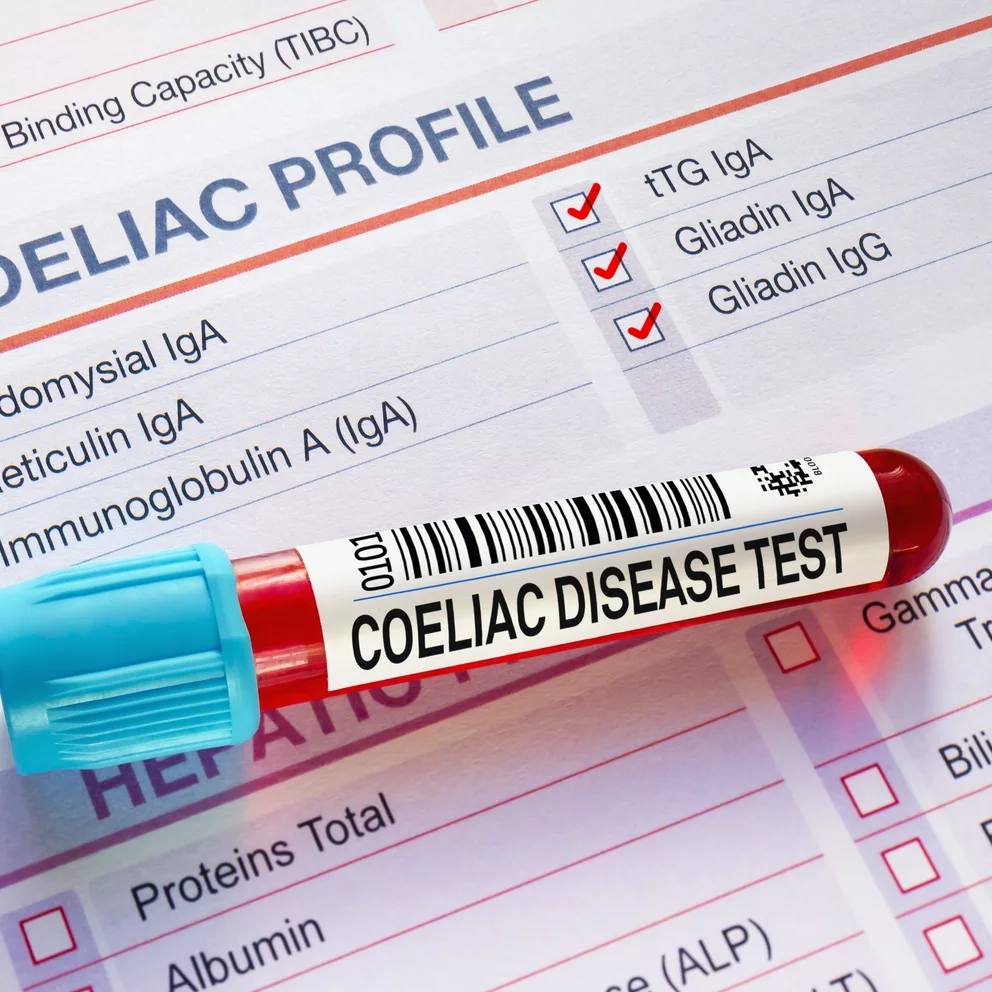
Serological examinations can confirm the suspicion of coeliac disease. Here, first and foremost, the anti-transglutaminase-antibodies (ATA) of the category lgA are examined. This is an extremely reliable and routine blood test. Equally significant, but carried out as a secondary measure, is the determination of anti-endomysial antibodies (EMA). The anti-gliadine-antibodies (AGA) of the category lgA and lgG are especially significant with children under the age of 2, as they give a clearer result than the other antibodies. The isolated change of AGA-lgG alone is not decisive enough for a diagnosis, except for children with an lgA deficiency.
Biopsy of the small intestine
With positive serological results a biopsy of the small intestine is recommended, which is done through a gastroscopy. If there are positive serological results, as well as typical changes in the area of the small intestine (villous atrophy, increase of the antibodies in the mucous membrane of the small intestine), then the diagnosis of coeliac disease can be definitely confirmed.
Endurance test
Sometimes people start following a gluten-free diet for reasons like irritable bowel syndrome or personal choice before undergoing diagnostic tests for coeliac disease. In such uncertain cases where a diagnosis of coeliac disease cannot be confirmed without a doubt, it is only confirmed when re-exposure to gluten leads to clinical and biopsy relapse within a few months (rarely years later). The medical supervision should be strictly followed during gluten re-exposure.
Related FAQs
 There are actually people where coeliac disease has been excluded but who, nevertheless, have symptoms similar to those of coeliac disease when they eat food containing gluten. This phenomenon is called non-coeliac gluten sensitivity or wheat...
 In the majority of patients with coeliac disease the gastrointestinal symptoms mostly disappear promptly as soon as one switches to a gluten-free diet. The other patients notice a distinct clinical improvement of the symptoms within a few weeks or...
 A gluten-free diet is essential for individuals diagnosed with coeliac disease, gluten sensitivity, or wheat allergy. However, for the general population without these conditions, adopting a gluten-free diet may not offer health benefits and could...
 Follow-up check-ups are recommended in order to avoid the appearance of deficiencies or complications or in order to check the diet-compliance (this indicates how well the affected person is sticking to the gluten free diet).
 Low bone mineral densisty can affect up to 75% of people when they are diagnosed with coeliac disease at any age. people with coeliac disease the intake of food containing gluten leads to an inflammation of the mucous membrane of the small intestine...

